Last Saturday I dropped off four art pieces for my first-ever gallery exhibition event. Doing this kind of thing was honestly not on my radar at all at the beginning of this year, and I almost can’t believe it’s happening. I owe a huge debt of gratitude to a person I’d never met before who visited my booth at Minneapolis People’s Pride this past June. They messaged me afterward, telling me about the miniARTure Art Show with The Otherworldly Arts Collective and that they thought my work would be a good fit for the show. That gave me the confidence to apply, and I was overjoyed when I was accepted.
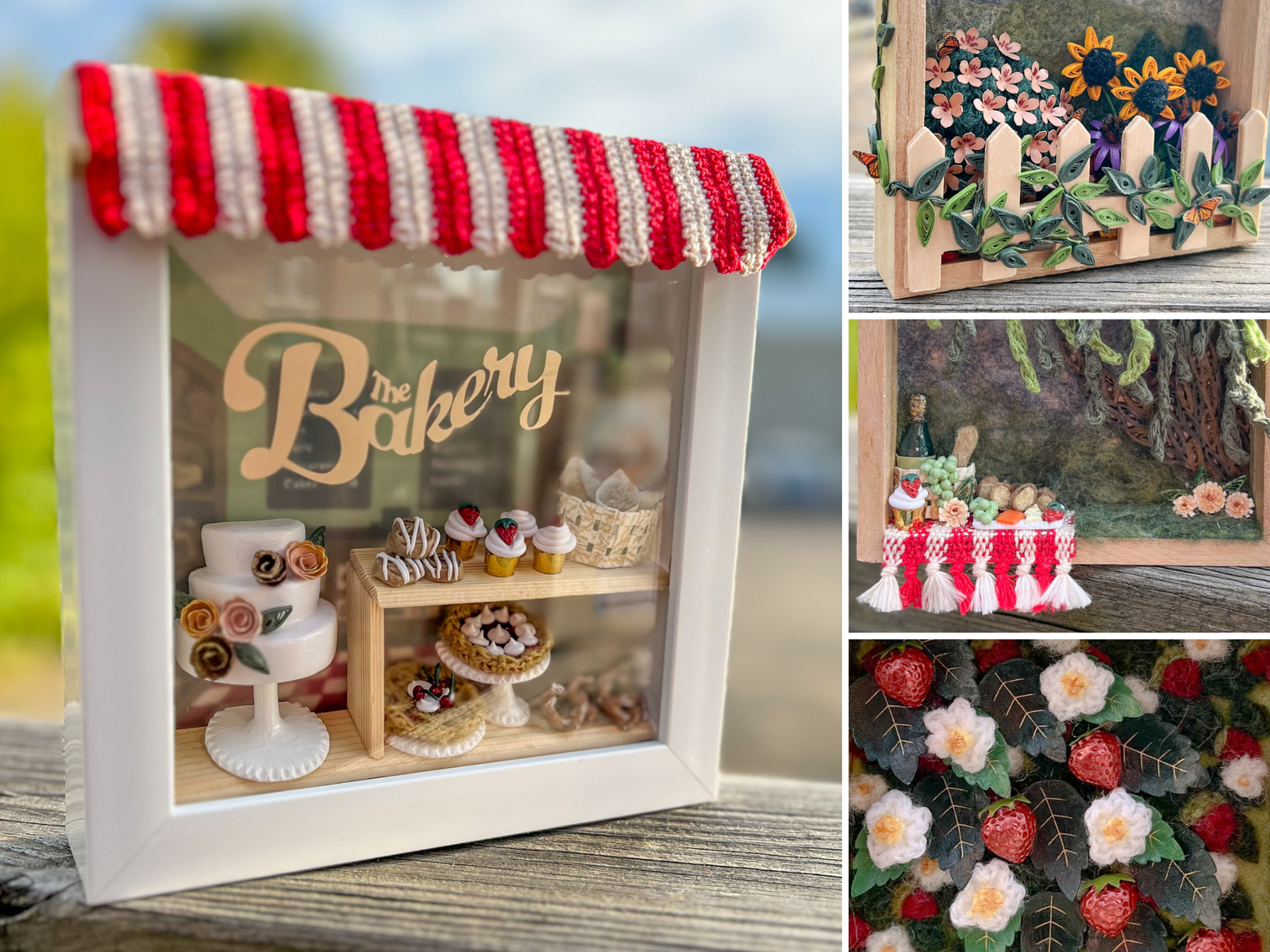
Several months later, I’ve got four pieces ready to show that have surprised me by fitting together into a narrative. I didn’t set out with a central theme in mind, other than the theme of food and flora that encompasses all of my work. I knew at the start that I wanted to do a bakery window, and the ideas for the other pieces came together somewhat independently. When they were all finished and I took a step back, I realized that they together tell the story of a strawberry. Here are the pieces I ended up with!
Pollinator Garden
2025. Fiber, paper, and wood. 5″ x 5″ x 1″.
The strawberry begins with pollination.
The monarch butterflies in this piece represent migration and the essential role that migrants play in our food system. In this piece I hope to convey the beauty of spaces that are intentionally welcoming for migrants and that celebrate their inherent value.
Strawberry Bush
2025. Fiber, paper, and polymer clay. 5″ x 5″ x 1″.
The strawberry grows and ripens.
This piece celebrates the beauty of fruiting plants. But what that beauty conceals is the hardship that farm workers undergo as they hand-pick berries for wages that are far lower than they deserve.
I have both practical and philosophical reasons for not depicting those conditions right now. First, rendering humans meaningfully is not one of my current artistic skills. Second, I do not want to visually represent a farm worker unless I work directly with them to present aspects of their experience that they want to share. As I grow as an artist, I hope to cultivate both the skills and the authentic relationships to achieve this.
The Bakery
2025. Mixed media. 7″ x 7″ x 2″.
The strawberry adorns a celebratory treat.
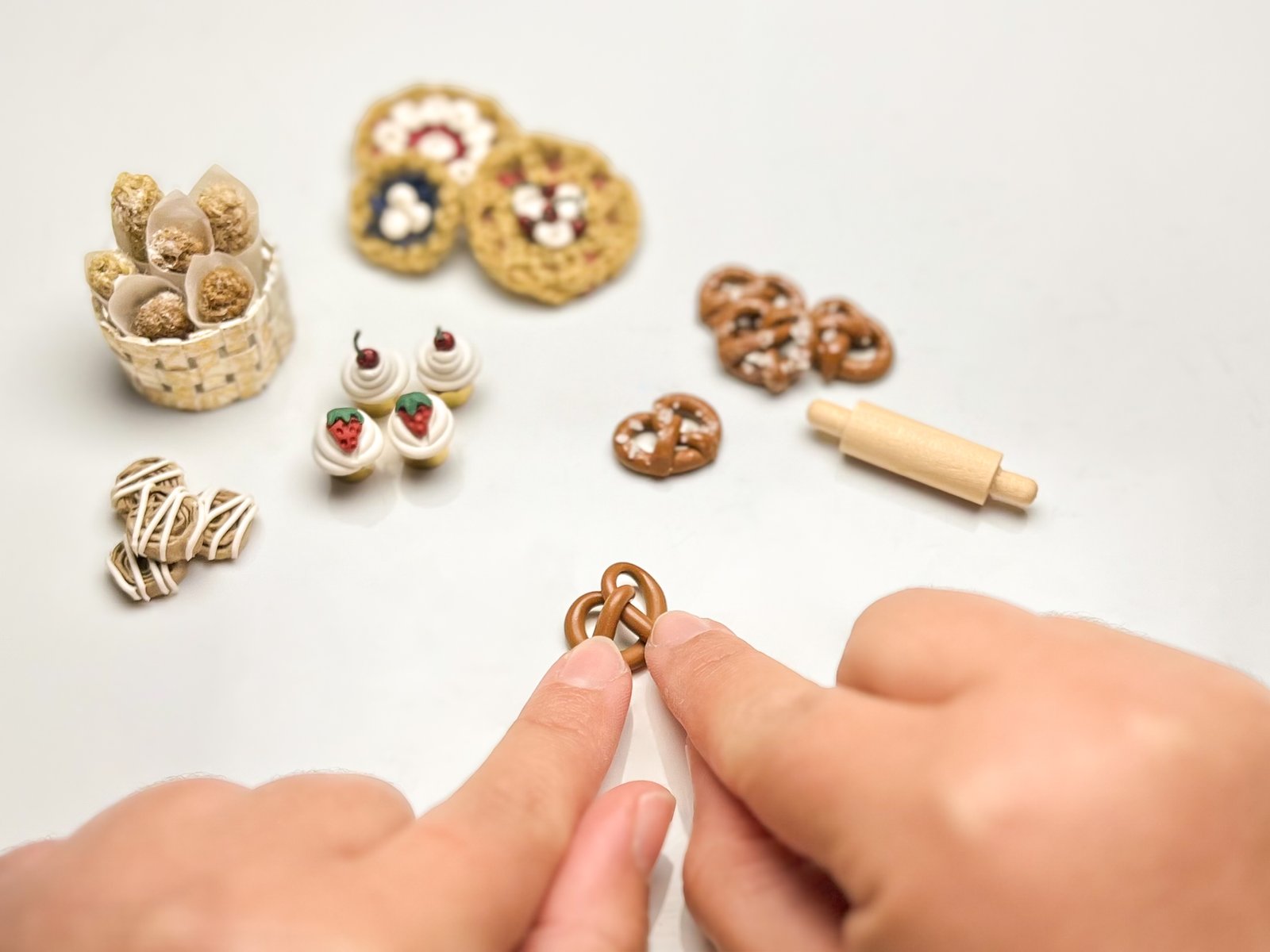
This piece is a celebration of the roles that food can play beyond providing nutrition. Food can be a work of art in itself and is often the centerpiece of important social events. I love the concept of a bakery window because I imagine a vibrant community where passers-by smile at the joyful whimsy of tasty treats.
Picnic Under a Willow
2025. Fiber, paper, and polymer clay. 5″ x 5″ x 1″.
The strawberry is the sweet end to a meal.
At first, this piece was just the willow, an experimentation with paper quilling and crochet. The picnic was inspired by The Bakery. I loved the red and white textile as well as the strawberry cupcakes from that piece. And I felt that the willow’s lazy lean and softly dangling boughs called for a peaceful picnic. I imagine this as a celebratory meal, complete with champagne, dessert, and floral decor. What’s the celebration? Anything at all.
In the lead-up to the exhibition, I’ve got a complex range of emotions. I’m genuinely proud of what I’ve created. And fretting over the many things that I’d criticize or want to change. I’m honored to participate in a collective exhibition with other local artists. And nervous that my offerings won’t stand up next to their incredible talent. I’m overwhelmingly grateful for the opportunity to show my work. And terrified that people will scoff at the prices I’m asking for these pieces that I’ve put so much time and care into.
These are the sweets and sours of showing my first mini collection. And just like tasting a strawberry, I think the balance of both makes the experience all the more exciting.
I have been noodling on this blog post for months. A question that’s been weighing heavily on me is how to approach pricing. A kind fellow crocheter who visited my booth recently gave me the nudge I needed to get this thing written.
“You’re way undercharging,” they said. And the truth is, I absolutely had been. This is largely intentional, although not entirely. Here are the issues I’ve been thinking about and what I’m planning to do about them.
Why I try not to price high
I really want my pieces to be accessible and affordable to lots of folks, especially those without a lot of disposable income. Part of my ‘theory of change’ for WAFFLE Studio is producing physical items that remind folks about the ongoing need for farm worker justice. Most of my pieces are tagged with a statement about the donations I make to my partner organizations and the link to this website where people can learn more. (And I’m working to make sure every piece I sell comes with this info.)
My hope is that when people receive gifts from loved ones and/or take home a piece of art that they enjoy, they will feel joyfully welcomed into the movement for a fairer food system. So I don’t want my pricing to be a barrier for folks who might want to participate in this way.
I am also extremely fortunate that my basic needs – food, housing, and healthcare – are securely met. Class privilege plus having an incredibly supportive partner means I don’t need to make much money from the business in order to survive. This work is a labor of love for me that is really fulfilling. And more than that, it feels like a responsibility.
That said, is my consistent undercharging the ‘right’ thing to do? Nope, not necessarily.
The issues with pricing low
First, I eventually have to at least break even in order to sustain this business (a huge revelation, I know). So far, I’ve been relying on savings and the generous financial support of my partner to cover my business expenses. Material costs, overhead costs (like this website and business insurance), steep booth fees (sometimes in the hundreds of dollars to sell at an event), transaction processing and listing fees, and design and organizational software subscriptions very quickly eat up my sales revenue and more. For those who might be curious, I’ve itemized some of these costs at the end of this post. Eventually, I have to grow the business into a self-sustaining operation.
Another issue is that just because I can survive without making a living wage off of this work doesn’t mean that I should. It’s probably not a huge surprise to most folks that it’s tough to make a living as an artisan. And it’s hugely inequitable that following an artistic passion is a career move disproportionately accessible to those with class privilege, like me. Artists and crafters already have to contend with consumers’ low pricing expectations influenced by global capitalism. By relying on other sources of financial support and setting prices that don’t reflect all my production costs (including a living wage), I might contribute to those expectations and unfairly impact other artists with less privilege than me.
And finally, another piece of my theory of change for WAFFLE Studio is generating financial support for my partner organizations and the important work they do. The more sales revenue I generate, the more I am able to donate. I have no illusions that I can single-handedly sustain these organizations through this work. But I believe that every little bit counts, especially in this bigoted political climate that villainizes the migrants who feed this country.
The Trump administration has already slashed federal funding for programs like maternal and child health research and threatens more cuts to programs like the Migrant Education Program. All while dumping a dizzying amount of money into the militarized immigration enforcement and detention system that targets activists and steals people from their homes, jobs, and families. We the people must step up and fill the gaps where we can, as we continue to fight for a government that serves all of us and respects the incredible contributions our immigrant neighbors make to our communities.
Building a mission-based pricing strategy
So what to do about these sometimes conflicting goals and values? The mission of WAFFLE Studio is to raise both funds and awareness to support the farm worker justice movement. An easy answer would be to try to price things right in the ‘middle’ between widely affordable and revenue-generating. But I don’t think that works well either, as everything being in the ‘middle’ serves neither goal especially well. I thought about implementing a sliding scale approach where folks can pay what they can/want within a suggested range. But I don’t want to create a situation where someone might feel obligated to pay the upper limit or feel guilty or embarrassed when they can’t.
And what do ‘low,’ ‘high,’ and ‘affordable’ even mean, anyway? All of this is relative, of course, based on people’s perceptions of what a particular item is worth. That’s going to differ slightly for each person, depending on their income, price comparisons they have already seen, how much they know about the production process, and how much value they place on locally-produced handmade items.
There are a lot of “how-to” guides out there purporting to know the “right” way to calculate pricing. I’ve found them to include some useful tips to start from, but there are always more questions left unanswered. For example, there is widespread agreement that your prices should reflect the time it takes to make the item. But what hourly rate for that labor is fair? And most formulas I’ve encountered include some sort of markup, profit margin, or multiplier. But what number makes sense for this?
Then, there’s the issue of overhead costs for things that don’t go directly into making the product but that are nevertheless important for running the business. Often the how-to guides recommend including a per-item overhead charge that will add up to cover your annual expenses. That requires having an estimate of how many items you will make and sell in a year. I’m just starting out and am learning to manage my newly diagnosed ADHD, so this is next to impossible for me right now.
So here’s what I’m going to do for now. It’s not the “right” thing, nor do I intend to use this approach forever. I’m sure a lot of folks out there will take issue with this plan. But it’s the only way I can think of that I feel okay about for the time being.
Materials
This is the most straightforward thing to determine. I can calculate the material cost by weight (e.g., for fiber and polymer clay) or by unit (e.g., for quilling strips or sheets of cardstock). Some of my materials are premium-quality and expensive (like 100% wool yarn), while others cost much less (like acrylic yarn I buy from secondhand stores or paper pulp that I recycle at home). So I plan to develop some product lines that use higher-quality materials and others that use less-expensive materials for folks on a tight budget.
Labor
I am going to use the minimum wage for where I live (Minneapolis, Minnesota) that takes effect in January of 2026: $16.37 per hour. I am only going to include the labor cost to physically make an item. So that excludes the countless hours I spend on administrative tasks, staffing my market booth, creating product listings, updating this website, and designing and testing new products.
In an ideal world, I would be able to pay myself a fair wage for all of that labor. But this is not an ideal world, and that’s the point. Is this naive? Maybe. Taking too much responsibility for problems I didn’t directly cause? Some people think so. I’m choosing not to care about that.
Multipliers
As I’ve mentioned, there are a lot of costs that I need to cover beyond just labor + materials. And I want to offer product lines that are widely accessible to lots of folks as well as product lines that will (hopefully) pay the bills.
I’m also aware that some of my pieces are more specialized and specific to my artistic style and skills than others. For example, there are lots of amazing fiber artists out there who – if they have the time and materials to do so – have the skills to make my crochet-only pieces. But I’ve got other pieces in the works that incorporate multiple media and techniques. So I think it’s reasonable to ask for a higher price since my mixed-media pieces are much more specialized. Here’s the grid that I’m going to use to determine which multiplier to use to help cover those additional costs so that my pricing reflects both the uniqueness of the item and the goal I hope it will achieve.
So, my base pricing formula going forward is going to be: [ material cost + (labor hours x 16.37) ] x multiplier. I will probably make tweaks up or down based on how sales go, feedback I get from folks at markets, etc. And some pieces I make for specific events like gallery shows have a commission percentage that I’ll need to account for. So I’ll be using this formula as a starting point and adjusting as needed. Is this approach going to turn a profit? Probably not. Is it going to be sustainable? I honestly don’t know yet. But I’m going to give it a try and see how it goes.
2025 Estimated Operational Costs
Fixed Costs
Creative software subscriptions: $380
Website costs: $277
Business insurance: $219
Quickbooks: $215
P.O. Box: $192
Total: $1,284
Craft Show Fees
Booth fees: $2,037
Application fees: $235
Additional costs required by organizers: $124
Total: $2,396
The cost of display equipment is not included here since the equipment is reusable in future years.
Other Fees
Square transaction fees: 2.6% + $0.15 per transaction
Venmo transaction fees: 1.9% + $0.10 per transaction
Etsy listing fees: $0.20 per listing or per sale of items available in-person only
Okay, so here’s the thing. Several weeks ago I put on my blog landing page that my first post would be “coming soon in May 2025!” As I write this, it’s after 8:00pm on May 31st. I have two drafts, three other posts started, and none that are ready yet to share with the world.
Upholding my commitments is really important to me.
I’ve struggled with perfectionism all my life. I also have Generalized Anxiety Disorder and ADHD. I’ve recently discovered some exciting new crafting skills that I’ve been guiltily putting more time into than I “should” have. I’ve had some extra stressors and drains on my time and mental energy lately. And I’ve had some joyful opportunities like my very first outdoor market that I put in a lot of effort into preparing for. I did not finish any of the posts that I started. And now I’m less than three hours away from breaking my word.
So here’s me keeping my promise that I’d publish my first post in May 2025.
I have no illusions that what I’m writing at the moment is groundbreaking. Quite possibly nobody but me and my incredibly supportive partner will actually read this. But I have to remind myself that that’s not the point of this blog. I’m doing this as a way to practice transparency and accountability.
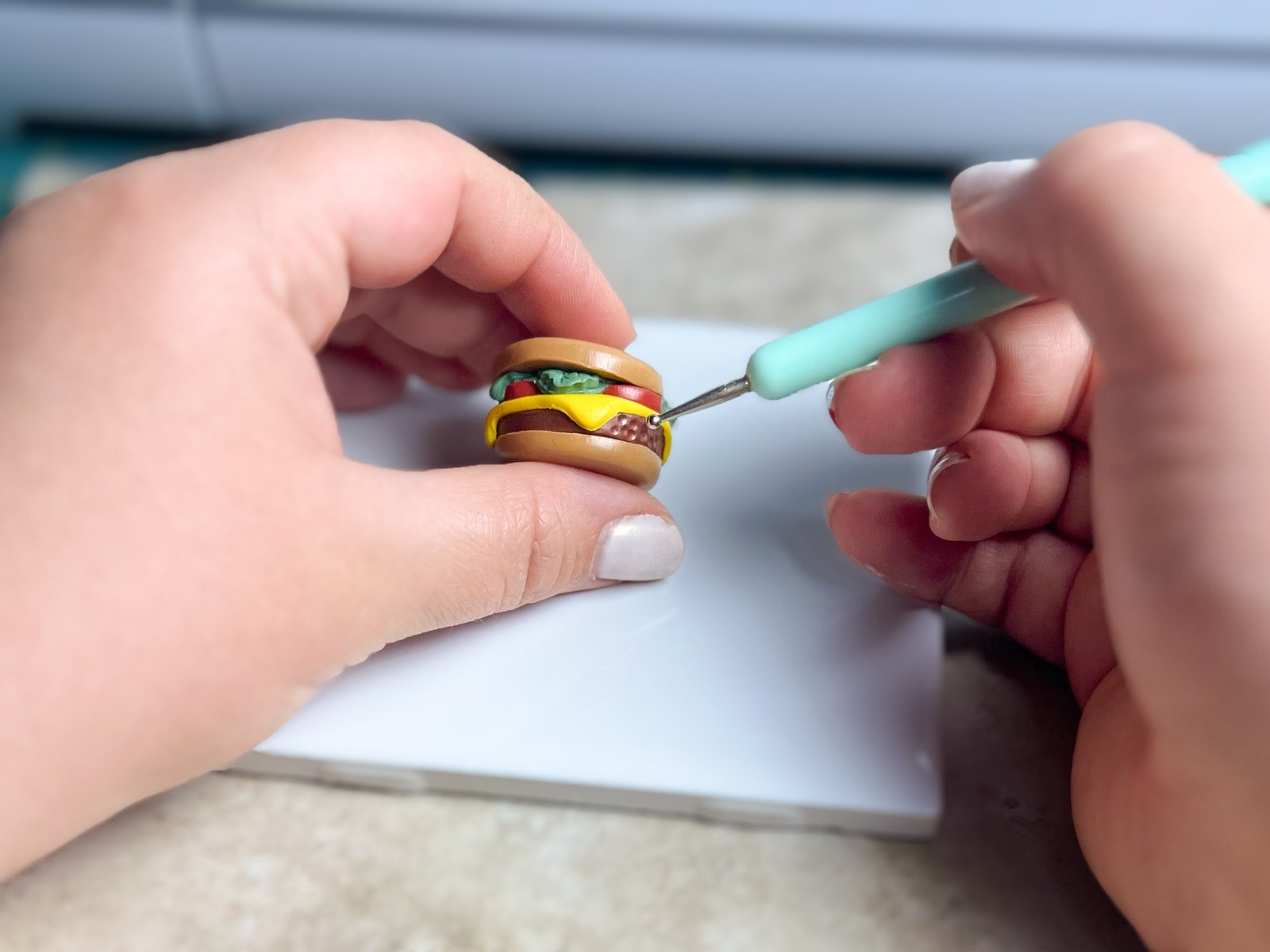
Trying to hide the fact that I’m quite messy, rather scatterbrained most of the time, and frankly terrible at ‘time management’ helps no one. I hope that owning that and–dare I say–even celebrating that might help me chip away at the perfectionism that so often keeps me from sharing what’s in my heart. And maybe others out there will see themselves reflected in these experiences and can feel a little less alone. Those hopes of mine are the lettuce and tomato on this nothing-burger of a post. I don’t have much to say that’s significant, but if it provides me and anyone reading this with a bit of nourishment, that makes it worthwhile.
Manage Consent
To provide the best experiences, we use technologies like cookies to store and/or access device information. Consenting to these technologies will allow us to process data such as browsing behavior or unique IDs on this site. Not consenting or withdrawing consent, may adversely affect certain features and functions.
Functional
Always active
The technical storage or access is strictly necessary for the legitimate purpose of enabling the use of a specific service explicitly requested by the subscriber or user, or for the sole purpose of carrying out the transmission of a communication over an electronic communications network.
Preferences
The technical storage or access is necessary for the legitimate purpose of storing preferences that are not requested by the subscriber or user.
Statistics
The technical storage or access that is used exclusively for statistical purposes.The technical storage or access that is used exclusively for anonymous statistical purposes. Without a subpoena, voluntary compliance on the part of your Internet Service Provider, or additional records from a third party, information stored or retrieved for this purpose alone cannot usually be used to identify you.
Marketing
The technical storage or access is required to create user profiles to send advertising, or to track the user on a website or across several websites for similar marketing purposes.